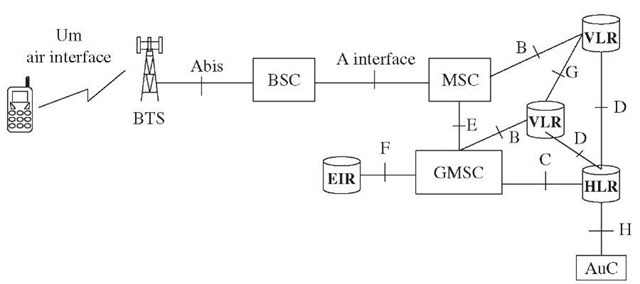
The GSM specifications define the interaction between system components through well-defined interfaces and protocols. Figure 3-11 shows the interfaces between the GSM functional entities. Table 3-3 lists the GSM interfaces.
Figure 3-12 shows the protocol architecture used for the exchange of signaling messages on each interface. The protocols are layered according to the OSI Reference Model. It consists of the Physical Layer, Data Link Layer, and Layer 3. This Layer 3 is not the same as defined in OSI Layer 3. In GSM, the Layer 3 functions include call, mobility, and radio resource management. In the OSI model, these functions are provided by the higher layers. GSM reuses a few established protocols such as CCS7 MTP, TCAP, SCCP, ISUP, and ISDN LAPD protocols. The MAP and BSSAP are new protocols to support GSM specific needs.
Air interface
The air interface between the MS and the BTS is called Um. The GSM air interface is based on time division multiple access (TDMA) with frequency division duplex (FDD). TDMA allows multiple users to share a common RF channel on a time-sharing basis, while FDD enables different frequencies to be used in uplink (MS to BTS) and downlink (BTS to MS) directions. Most of the implementations use a frequency band of 900 MHz. The other derivative of GSM is called Digital cellular system 1800 (DCM1800).

Figure 3-11 GSM interfaces.
TABLE 3-3 GSM Interfaces
Interface | Description |
Um |  |
Abis |  |
A |  |
B |  |
C |  |
D |  |
E |  |
F |  |
G |  |
H |  |
It uses a frequency band of 1800 MHz. Table 3-4 lists the GSM frequency bands.
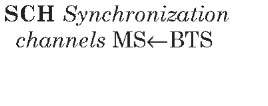
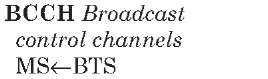
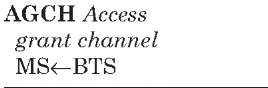
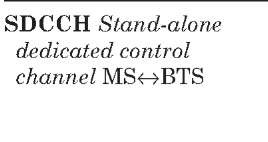
The used frequency band is divided into 200-kHz carriers or RF channels in both the uplink and downlink direction. Each RF channel is then further subdivided into eight different timeslots, i.e., 0 to 7, by TDMA techniques. A set of these eight timeslots is referred as a TDMA frame. Each frame lasts 4.615 ms. The physical channels are further mapped to various logical channels carrying user traffic and control information between the MS and the BTS. Table 3-5 describes the logical channels and their usages.
The following section describes the Um interface protocols used at the MS and the BTS side.
Physical layer. Layer 1, which is a radio interface, provides the functionality required to transfer the bit streams over the physical channels on the radio medium. The services provided by this layer to those above include:
■ Channel mapping (logical to physical)
■ Channel coding and ciphering
■ Digital modulation
■ Frequency hopping
■ Timing advance and power control
Data link layer. Signaling Layer 2 is based on the LAPDm protocol, which is a variation of the ISDN LAP-D protocol. The main task of LAPDm is to provide a reliable signaling link between the network and the mobile station. The LAP-D protocol has been modified to adapt in the mobile environment. For example, LAPDm uses no flags for frame delimitation. The Physical Layer itself does the frame delimitation. This way, scarce radio resources are not spent on flag bits the bit.

Figure 3-12 GSM protocol stack.
TABLE 3-4 GSM Frequency Bands
System | Direction | Frequency band (MHz) |
GSM 900 | Uplink | 890-815 |
| Downlink | 935-960 |
GSM/DCS1800 | Uplink | 1710-1785 |
| Downlink | 1805-1880 |
Network layer. Signaling Layer 3 takes care of signaling procedures between an MS and the network. It consists of three sublayers with distinct signaling procedures.
■ Radio resource management (RR)
■ Mobility management (MM)
■ Connection management (CM)
Radio resource management. Radio resource management (RR) comprises procedures required to establish, maintain, and release the dedicated radio connections. The RR sublayer functions include:
■ Channel assignment and release
■ Ciphering
■ Modification of channel modes, e.g., voice and data
■ Handover between cells
■ Frequency redefinition to enable frequency hopping
■ MS measurement reports
■ Power control and timing advance
■ Paging
■ Radio channel access
The mobile station always initiates an RR session. For example, the RR procedures are invoked to establish an RR session in response to a paging message or to establish an outgoing call. As shown in Figure 3-13, the RR messages are transferred to BSC transparently, through the BTS. Table 3-6 lists RR messages.
Mobility management. The mobility management (MM) sublayer handles functions and procedures related to mobility of the mobile user. This includes procedures for:
■ Authentication
■ Location registration and periodic updating
TABLE 3-5 Logical Traffic and Control Channels
TABLE 3-5 Logical Traffic and Control Channels
| Traffic channels (TCH) |
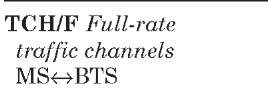
 | TCH/F carries subscriber information (speech/data) at a rate of 22.8 Kbps with a speech coding at around 13 Kbps. |
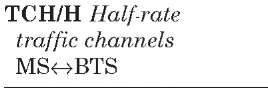
 | TCH/F carries subscriber information at a rate of 11.4 Kbps with a speech coding at around 7 Kbps. |
| Broadcast control channels (BCH) |
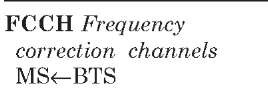
 | This channel is broadcast by the BTS and carries information for the frequency correction of the MS. It is used in downlink direction only. |
 | This channel is broadcast by the BTS and carries information for frame synchronization of the MS. In addition it also carries the base station identity code (BSIC). It is used in downlink direction only. |
 | This channel carries broadcast information related to the BTS and the network. The information includes configuration details of common control channels (CCH) described below. |
| It is used in downlink direction only. |
| Common control channels (CCH) |
 | This is used to page an MS. It is used in downlink direction only. |
 | The MS uses this channel to request the allocation of a SDCCH. It is used in uplink direction only. |
 | The BTS allocates a SDCCH or TCH in response to the allocation request by the MS using this channel. It is used in downlink direction only. |
| Dedicated control channels (DCH) |
 | This channel is used for carrying signaling information between the BTS and a MS before allocation of a TCH. For example, SDCCH is used for carrying signaling messages related to update location and call establishment. This is a bidirectional channel. |
 | This channel is always used in conjunction with a TCH or a SDCCH. The MS and the BTS use it to maintain an SDCCH or a TCH. In the uplink, the MS sends measurement reports to the BTS using this channel. In the downlink, the BTS transmits information to keep the mobile updated on recent changes in system configuration. |
 | This channel is always associated to a TCH and is used to transfer signaling messages when a mobile is already involved in a call. |

Figure 3-13 Air interface signaling protocols.
■ Security
■ TMSI reallocation
■ IMSI detach/attach
As shown in Figure 3-13, the CM layer from the transmitting side uses the MM layer to establish RR connection and then transfers messages transparently across to the receiving side, that is MSC. Table 3-6 lists MM messages.
Connection management. The connection management (CM ) sublayer contains the functions and procedures for call control. This includes procedures to establish, release, and access services and facilities. The CM consists of three sublayers, namely, call control (CC), supplementary services (SS), and short message services (SMS).
The call control sublayer provides procedures for ISDN call control. These procedures are based on ISDN call control procedures defined in the ITU-T Q.931 specification. However, the minor modifications are done to adopt these to mobile environment.
The supplementary service sublayer provides the procedures to support non-call-related supplementary services such as call forwarding and call waiting.
TABLE 3-6 Layer 3 Messages
RR messages | MM messages | CM messages |
Channel establishment messages | Registration messages | Call establishment messages |
ADDitional ASSignment | IMSI DETach | ALERTing |
INDication | |
IMMediate ASSignment | LOCation UPDating | CALL CONFirmed |
ACCept | |
IMMediate ASSignment | LOCation UPDating | CALL PROCeeding |
EXTended | REJect | |
IMMediate ASSignment | LOCation UPDating | CONnect |
REJect | REQuest | |
Paging messages | Connection | CONnect |
management messages | ACKnowledge |
PAGing REQuest Type 1 | CM SERVice ACCept | SETUP |
PAGing REQuest Type 2 | CM SERVice REJect | EMERGency SETUP |
PAGing REQuest Type 3 | CM SERVice REQuest | PROGRESS |
PAGing ReSPonse | CM SERVice ABOrt | Call phase messages |
Handover messages | CM REeStablishment | MODify |
| REQuest | |
ASSignment CoMmanD | Security messages | MODify REJect |
ASSignment COMplete | AUTHentication REJect | MODify COMPlete |
ASSignment FAILure | AUTHentication | USER INFOrmation |
HANDover ACCess | REQuest | |
HANDover CoManD | AUTHentication | HOLD |
| ReSPonse | |
HANDover COMplete | IDENTity REQuest | HOLD REJect |
HANDover FAILure | IDENTity ReSPonse | HOLD ACKnowledge |
PHYsical INFOrmation | TMSI REALlocation | RETRIEVE |
| COMmand | |
Ciphering messages | TMSI REALlocation | RETRIEVEREJect |
| CoMPlete | |
CIPHering MODe CoMmanD | Other messages | RETRIEVE |
| | ACKnowledge |
CIPHering MODe COMplete | MM STATUS | Call clearing messages |
Channel release messages | ABORT | DISConnect |
CHANnel RELease | | RELease |
PARTial RELease | | RELease COMplete |
PARTial RELease COMplete | | Other messages |
System information messages | | CONGESTion |
| | CONTROL |
SYStem INFOrmation Type1 | | STATUS |
SYStem INFOrmation Type2 | | STATUS ENQuiry |
SYStem INFOrmation Type3 | | NOTIFY |
SYStem INFOrmation Type4 | | START DTMF |
SYStem INFOrmation Type5 | | STOP DTMF |
SYStem INFOrmation Type6 | | START DTMF |
SYStem INFOrmation Type7 | | ACKnowledge |
SYStem INFOrmation Type8 | | |
SYStem INFOrmation | | STOP DTMF |
Type 2bis | | ACKnowledge |
SYStem INFOrmation | | START DTMF REJect |
Type 5bis | | |
TABLE 3-6 Layer 3 Messages
RR messages | MM messages | CM messages |
Other messages | | |
CHANnel REQuest | | |
CHANnel MODe MODify | | |
CHANnel MODe MODify | | |
ACKnowledgment | | |
CLASSmark ENQuiry | | |
CLASSmark CHANGE | | |
FREQuency | | |
REDEFinition | | |
RR Status | | |
MEASurement REPort | | |
The short message service sublayer provides the procedures to support the short message transfer between the MS and the network. Table 3-6 lists CM messages.